Rings That Don't Turn Your Finger Green: The Definitive Guide

Rings That Don't Turn
Your Finger Green
The green ring of shame is not about cheap taste or sweaty hands. It is one specific metal misbehaving, and it is completely avoidable.
Want to skip the chemistry lesson? Every ring in the waterproof ring collection is copper-free by design.
Why Rings Turn Fingers Green
The green mark is copper oxide: the metal in your ring reacting with the acids in your sweat, and rings are the worst-affected jewellery there is.
Most fashion rings are brass or copper alloy under a thin plated finish. Fingers are warm, slightly acidic and frequently damp, hand-washing alone soaks a ring a dozen times a day. Once the microscopic plating wears at the pressure points inside the band, the copper beneath oxidises against your skin and transfers as that grey-green stain.
It is harmless, it washes off, and it is not an allergy in most cases. But it is a countdown timer: once a ring starts marking, the plating is breached and the marks only get more frequent. The full chemistry, and the fixes that do and do not work, are in our jewellery turning green guide.
The Myths That Keep the Problem Alive
Three pieces of folk wisdom guarantee you keep buying rings that mark.
"Clear nail polish fixes it." Temporarily, at best. The polish layer wears off inside a week of hand-washing, and reapplying it forever is not a jewellery care routine, it is a subscription to a problem.
"It means the gold is fake." Not quite: it means the gold layer is thin and the base is copper-bearing. Plenty of honestly-labelled gold-plated brass behaves exactly this way; the issue is the recipe, not deception.
"My skin is just acidic." Skin chemistry varies, but no skin turns green against copper-free metals. Blaming your body lets the actual culprit, the alloy, off the hook.
Ring Materials, Ranked Honestly
Rings take more abuse than any other jewellery: friction, pressure, water, sanitiser. The material bar has to be higher.
| Material | Green-mark risk | Shower-safe | Verdict |
|---|---|---|---|
| Brass / copper alloy, plated | High once plating wears | No | The usual suspect |
| Sterling silver 925 | Low (occasional, from the copper content) | Rinse only | Good, needs polishing |
| Gold vermeil | Low until heavy wear | Cautiously | Better, still layered |
| Titanium | None | Yes | Excellent, limited styles |
| 316L stainless steel | None | Yes | The everyday answer |
| 316L steel + 18k gold PVD | None | Yes | Gold looks, zero green |
| Solid gold 14k+ | None | Yes | Perfect, priced accordingly |
The pattern repeats from our necklaces guide: remove the copper, remove the problem. 316L stainless steel contains no free copper to oxidise, and a PVD-bonded 18k gold finish means the colour is not a thin sacrificial layer but a molecularly bonded coat engineered for exactly the friction rings endure.

Stacking Rings
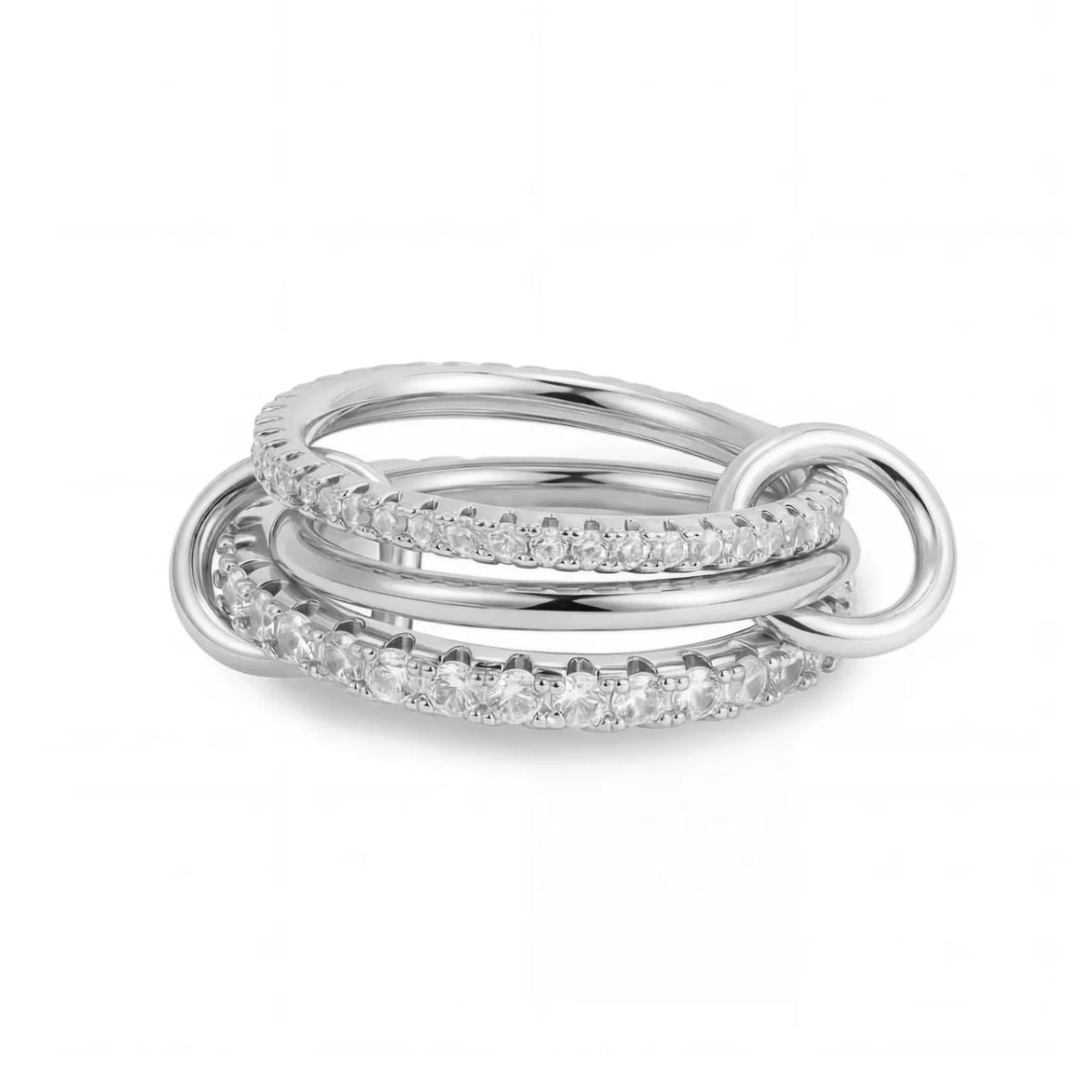
Stacking is where green marks multiply, more bands, more contact points, more friction between rings. Copper-free stacking bands end the issue and free you to build the stack you actually want: two today, five on the weekend. PVD-coated steel bands also survive the ring-against-ring wear that strips electroplated finishes fastest.

Personalised Rings
A ring that carries an initial or a name is a ring you intend to wear forever, which makes copper-free construction non-negotiable. Nothing undermines a sentimental piece like a green stripe under the band. Personalised rings in 316L steel with 18k PVD carry the meaning without the countdown timer.
Rings You Can Shower With
The shower question is really the materials question in disguise.
A ring that cannot get wet is a ring you will eventually lose on a sink edge. PVD-coated stainless steel rings are engineered for water: shower daily, wash your hands endlessly, swim on holiday. The finish neither tarnishes nor feeds a green reaction, and a lifetime colour warranty on the plating backs it. The wider rules for wearing jewellery in water are in our jewellery safe for water guide.
Green Marks vs Allergies: Reading Your Skin's Signals
Not every ring reaction is the copper stain, and telling them apart changes what you should buy next.
The green-grey smudge that wipes away is copper oxide transfer: cosmetic, harmless, a materials problem with a materials fix. Redness, itching or small blisters under the band are a different mechanism: contact dermatitis, most commonly triggered by nickel release from cheap alloys. It typically appears hours after wear and outlasts washing.
The nickel point deserves precision, because "stainless steel contains nickel" scares some buyers unnecessarily. In 316L surgical steel the nickel is bound tightly in the alloy matrix; release rates fall far below the EU/UK REACH thresholds, which is why the grade is used for implants and piercings. People with severe diagnosed nickel allergy should still patch-test any new metal, but for the vast majority of reactive-skinned wearers, 316L ends both the stain and the itch. Our sensitive skin jewellery guide covers the dermatology in depth.
The third signal, a dark grey smudge rather than green, is usually metallic abrasion: powdery makeup or lotions micro-polishing the metal onto skin. It follows cosmetics rather than sweat, and moves when your routine does. Different cause, same conclusion: harder, copper-free surfaces shrug it off.
Ring Sizing: The Part Everyone Gets Wrong
Material solves the green problem; fit decides whether you enjoy the ring. The two interact more than people think.
A too-tight ring traps moisture and soap against skin, which accelerates every reaction chemistry allows, including the copper one on cheap rings and plain irritation on good ones. A too-loose ring spins, and a spinning stone-set ring wears its own shoulders against desks. Correct fit is a comfort feature and a durability feature at once.
Measure at the end of the day, when fingers are largest, and remember knuckle-dominant fingers need the band to clear the knuckle then sit snug behind it. UK sizing runs on letters; if you know a continental or US size, conversion charts translate cleanly, and our sizing guidance on product pages walks the string-and-ruler method for measuring at home. Stacking changes the calculation slightly: three thin bands wear tighter than one wide one on the same finger, so stackers often size a half-step up on the outer bands.
One practical advantage of copper-free construction here: steel rings can be worn while you wash your hands endlessly during the sizing-in period, no removal ritual while you decide which finger a new ring lives on. The full stacking grammar is in how to stack rings.
Gifting Rings Without Fear
Rings are the highest-stakes jewellery gift, size, symbolism and skin all in play, and green-proof materials remove one of the three fears entirely.
Material fear is the silent one: nothing deflates a gift like a green stripe a fortnight later, and with copper-free steel that outcome is off the table. Size fear shrinks with adjustable and open-band designs, several of the most giftable styles are one-size by construction. Symbolism fear, does a ring say too much?, is solved by finger and style: stacking bands and personalised initial rings read as style and sentiment, not proposals, especially given openly as part of a set.
For milestone gifts, an engraved or initial ring in waterproof construction has a specific advantage: it can genuinely be worn every day immediately, through showers and gym sessions, so the gift enters daily life instead of waiting in a box for occasions. That daily-wear reality is why personalised rings hold their place in our gift guides alongside the safer necklace option, and the promise ring meaning guide settles the symbolism question for the romantic cases.
Why 316L Specifically, and What the L Means
The grade number on the materials line is doing real work. Here is the two-minute metallurgy.
316 stainless steel is an austenitic alloy of iron with chromium, nickel and, crucially, molybdenum, the addition that hardens its corrosion resistance against chlorides: sweat, sea water, pool chemistry. The L stands for low carbon, a refinement that keeps the alloy stable and non-reactive even where it has been worked and welded. The combination is why 316L is the default for surgical implants, marine fittings and professional piercing jewellery: environments where metal must sit against wet, salty, living tissue indefinitely without misbehaving.
A ring is, chemically speaking, a mild version of that environment: warm skin, daily soap, occasional sea. Specifying 316L rather than generic "stainless steel" rules out the cheaper 200-series alloys that trade corrosion resistance for cost, and it is the difference between a claim and a specification. The PVD gold layer on top then handles aesthetics: bonded titanium-nitride-based coatings carrying the 18k colour, hard enough to out-wear electroplate many times over. Specification reading turns out to be the entire secret of green-proof shopping, and our everyday metals guide extends the habit to every jewellery category.
A Green-Proof Ring Wardrobe in Four Pieces
Most ring collections grow by accident. Four deliberate pieces cover every day and every occasion, with zero green risk.
The daily band: a plain or subtly textured band in PVD gold that lives on your hand through everything, the piece that proves the construction. The stack set: two or three slim mixed-texture bands, plain, pavé, shaped, that dress the daily band up or spread across fingers. The statement: one stone-set or sculptural piece for evenings, safe in the knowledge that occasional wear will not tarnish it in the drawer. The personal piece: an initial or engraved ring that makes the whole wardrobe yours; the personalised ring collection covers letters, names and birthstones.
Four pieces, roughly £120 to £200 all-in at waterproof-category prices, and the collection is complete for years: no replacements, no polishing rota, no green stripes before payday. Build it one piece per occasion, birthday, Christmas, a milestone, and the wardrobe assembles itself inside a year.
Green-Proof Rings for Teens and First Jewellery
First rings are where the green-finger lesson is usually learned, expensively. It can be skipped entirely.
Teen jewellery budgets historically bought exactly the brass-under-plating construction that greens fastest on exactly the wearers least likely to follow care rituals. The waterproof tier changed the maths: green-proof, shower-proof rings now start under £30, which puts first-ring money on the right side of chemistry for the first time. For sensitive young skin, the hypoallergenic case is the same one made throughout this guide: no copper, bound nickel, nothing to react. Our teen jewellery guide maps the styles that survive school days.
The gift formula for a first ring: adjustable or open-band sizing (growing hands, unknown sizes), an initial or birthstone for meaning, and steel-PVD construction so the ring's first year, its hardest, ends with it still looking like a gift. Rings learned young this way recalibrate expectations for life: a generation that never met the green stripe will simply refuse it later.
The Key Takeaways
The chemistry lesson in five lines.
- Green marks are copper, full stop: skin acids oxidising brass alloys, harmless, wipeable, and completely avoidable.
- 316L stainless steel ends it: no free copper, bound nickel, the same grade as surgical implants, under a PVD-bonded 18k finish.
- The folk remedies fail: nail polish flakes, toothpaste abrades, and blaming your skin chemistry protects the real culprit.
- Fit is part of durability: measured at day's end, clearing the knuckle, snug behind it, tight rings accelerate every reaction.
- Four rings make a green-proof wardrobe: daily band, stack set, statement, personal piece, roughly £120 to £200 once, for years.
Frequently Asked Questions
Why do my rings always turn my finger green?
Because they contain copper, usually as brass under thin plating. Skin acids oxidise the copper and the residue transfers as a green mark. Copper-free metals like 316L stainless steel never do this.
Are green marks from rings harmful?
No, copper oxide is harmless and washes off. But it signals the plating is breached, so the marking will recur and usually worsen.
Does clear nail polish stop a ring turning your finger green?
Briefly. The polish wears off within days of hand-washing and needs endless reapplication. Replacing the ring with a copper-free material is the only permanent fix.
What rings can you shower with?
Solid gold, titanium and PVD-coated 316L stainless steel all handle daily showers. Plated brass and, to a lesser degree, sterling silver should stay dry.
Do stainless steel rings turn fingers green?
No. 316L stainless steel contains no free copper, so there is nothing to oxidise against your skin. With an 18k PVD gold finish, you get gold looks with zero green risk.
Is the green mark an allergy?
Usually not. The wipeable green-grey smudge is harmless copper oxide. Itching, redness or blisters suggest nickel contact dermatitis, a genuine sensitivity, and both problems are avoided by 316L stainless steel.
Can I wear stainless steel rings while washing dishes?
Yes. Washing-up liquid and warm water do not affect PVD-coated steel. Harsh solvent cleaners and abrasive scouring are the only kitchen enemies, for your ring and your hands alike.
Do adjustable rings turn fingers green?
Only if they are made of copper-bearing alloy, the adjustability is irrelevant. An adjustable band in 316L steel with PVD coating is as green-proof as a fixed one, and solves gift sizing at the same time.
What does 316L mean on a jewellery listing?
A specific stainless steel grade: chromium-nickel-molybdenum alloy, low carbon, the grade used for surgical implants and piercing jewellery. It signals genuine corrosion resistance rather than generic "stainless" marketing.
Are PVD gold rings scratch-proof?
Scratch-resistant, not scratch-proof: PVD coatings are many times harder than electroplate but no finish survives deliberate abrasion. Normal daily wear, keys, handwashing, gym grips excepted, leaves them looking new for years.
Wear Them Everywhere
Copper-free 316L stainless steel in 18k gold PVD: shower-proof, green-proof, hypoallergenic, with a lifetime colour warranty on the plating.
Shop Waterproof RingsBuilding a stack? Read how to stack rings first.